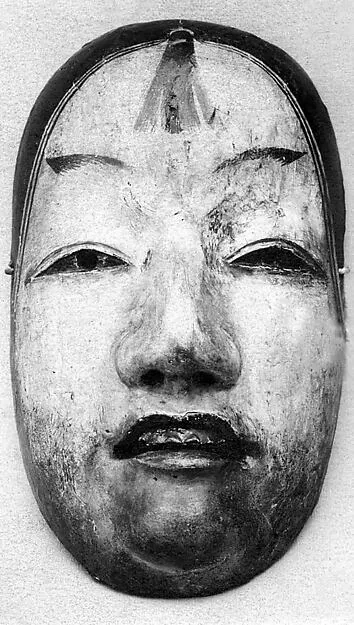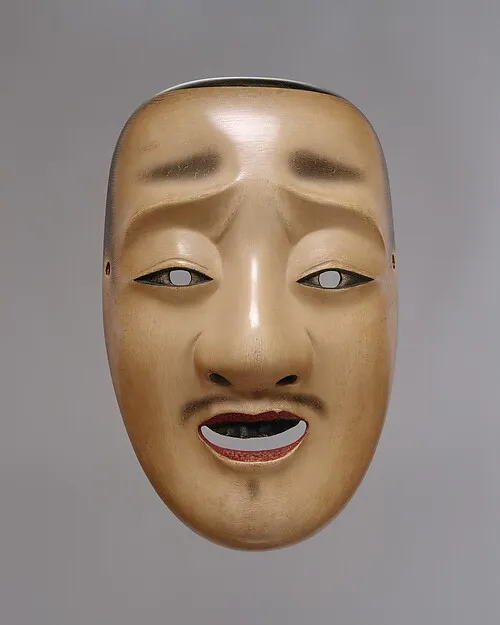
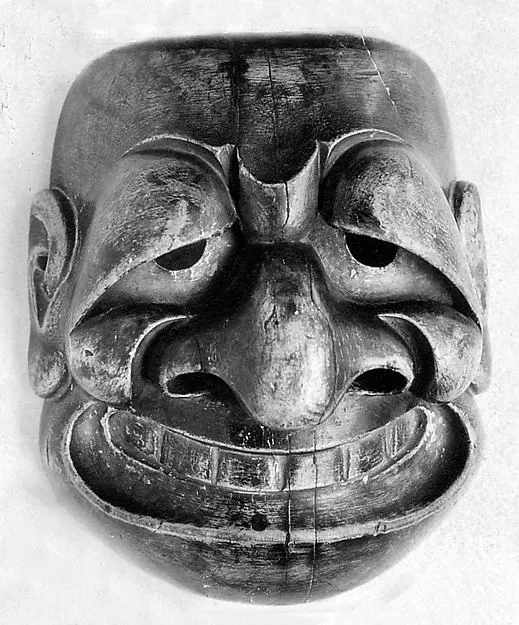
01Japan · 18th century
Noh mask
- Material
- Wood
- Record
- 22.121 · API 60222
A wood Noh mask catalogued by The Met with a broad eighteenth-century date. The record is our boundary: we do not infer a role or character from appearance alone.
Objects · evidence · making
Materials, makers and documented histories behind decorative and ceremonial masks held in museum collections.
Explore the Collection
Wood, metal, textile, stone, fiber and the language used to document them.
↗02Carving, casting, joining, painting and preservation—always tied to a specific record.
↗03Maker, place, date, collection history and the responsible expression of uncertainty.
↗Open-access collection study
Every identification below comes from a live museum record. The images are public-domain works supplied through The Met Open Access programme.
01Japan · 18th century
A wood Noh mask catalogued by The Met with a broad eighteenth-century date. The record is our boundary: we do not infer a role or character from appearance alone.
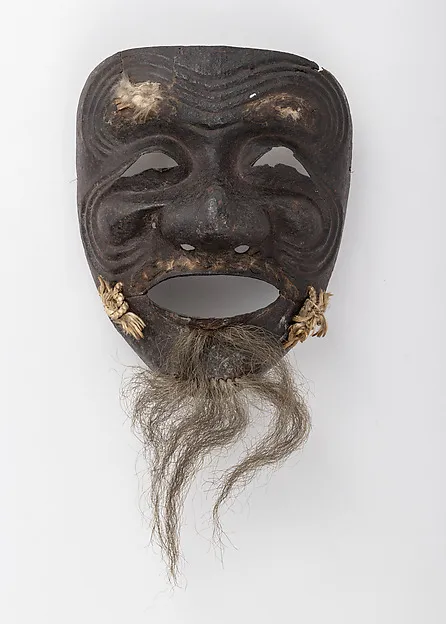
02Japan · 1336–1573
The catalogue dates this lacquered wood mask to a range rather than a single year, a useful reminder that object labels often preserve uncertainty.
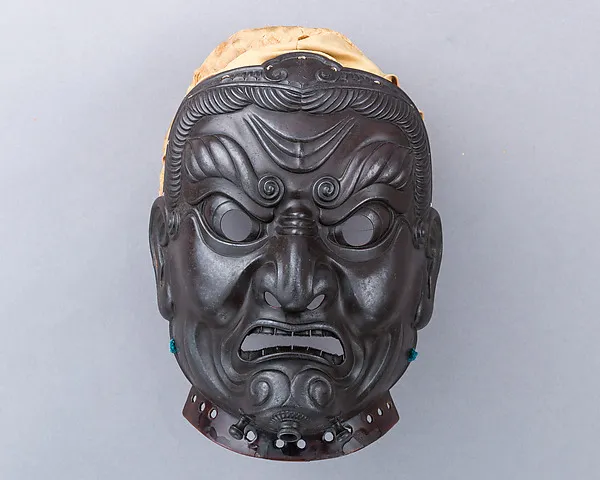
03Japanese · Possibly 15th century
A composite object whose label records iron, lacquer, hair and silk. The word “possibly” is part of the attribution and remains visible here.
04Japanese · Dated 1745
A dated iron mask catalogued with the maker Myōchin Muneakira. This is one of the collection records in which a named maker is part of the published evidence.
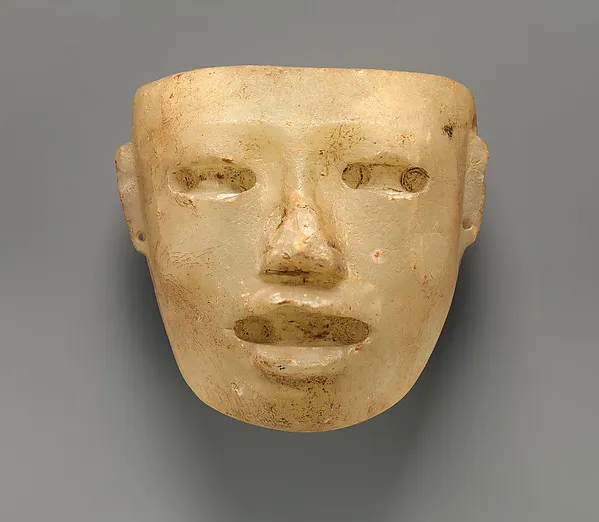
05Teotihuacan · 3rd–7th century
A stone mask documented as Teotihuacan and dated to a four-century range. The museum record, not stylistic guesswork, supplies that cultural identification.
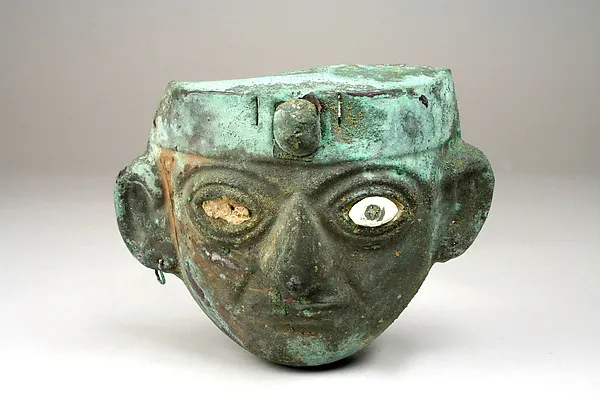
06Moche · 6th–7th century
A Moche mask whose catalogue material line combines silvered copper, shell and stone, showing why “metal mask” is often too imprecise a description.
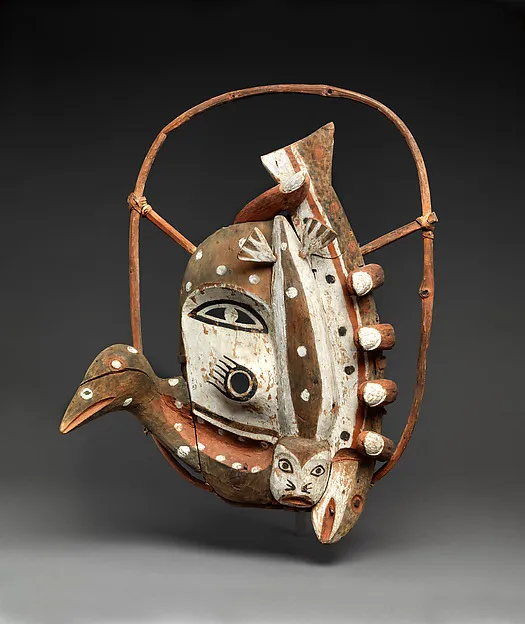
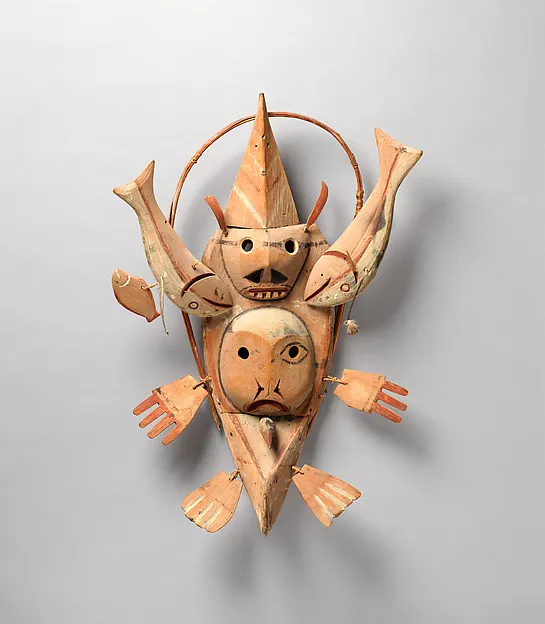
07Yup’ik, Native American · Circa 1900
A catalogue record identifying Yup’ik culture and three material groups. “Circa” signals an approximate date, not a hidden exact year.
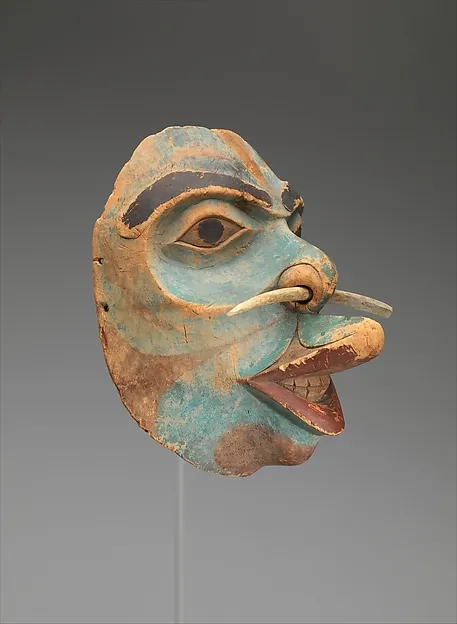
08Tlingit · Circa 1825
A wood-and-paint object catalogued as Tlingit. The page preserves the approximate date and avoids assigning symbolism without object-specific evidence.
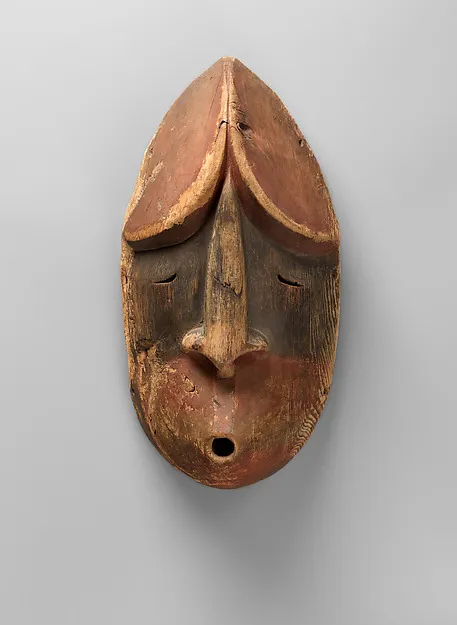
09Alutiiq / Sugpiaq, Native American · Circa 1870
The Met record identifies this object with Alutiiq/Sugpiaq culture and Kodiak Island. We retain both names and do not simplify the catalogue language.
10Yup’ik, Native American · Circa 1900
A materially complex catalogue entry that names vegetal fiber, iron nails and feathers in addition to wood and pigment.
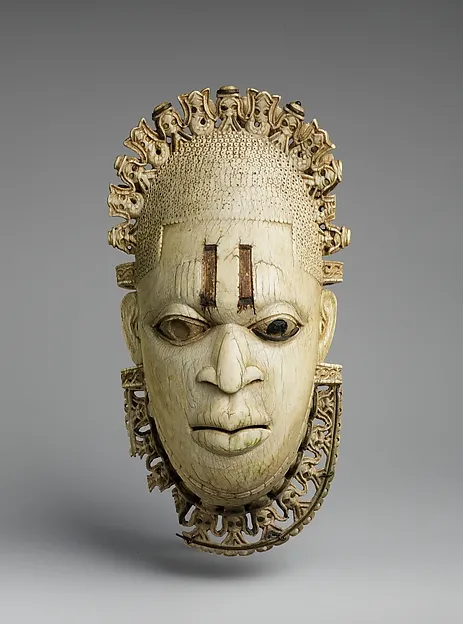
11Edo peoples · 16th century
A pendant mask identified by The Met with Edo peoples and Ìyọ́bà Idià. Its catalogue title and material line are presented without adding invented ritual claims.
12Japan · 18th century
A cypress-wood Noh mask whose museum record names Genkyu Michinaga and specifies three pigment colours.
Featured stories
Six close-reading guides to material, making, documentation, care and responsible reuse.
Craft · 7 min read
A material-first guide to carving evidence—without turning one documented practice into a universal recipe.
Materials · 6 min read
Why a material list is a starting point—and why colour on screen is never a chemical identification.
Interpretation · 8 min read
A practical boundary between close looking, catalogue evidence and unsupported symbolism.
Museums · 7 min read
From object type and measurements to maker, date, markings and ownership history.
Conservation · 7 min read
Why composite objects need preventive care shaped by several materials at once.
Practice · 6 min read
Rights clearance is only one part of responsible reproduction.
From material to object
These stages are a framework for asking questions. They must never be presented as a method shared by every maker or culture.
Study craft techniquesWhat material does the record name, and how secure is the identification?
Was a block seasoned, a metal sheet formed or a fiber structure assembled?
Which cuts, joins or cast surfaces are documented or visibly observable?
Where do tool marks survive, and what can they establish without speculation?
Which pigments, coatings or inlays have actually been identified?
How do light, handling, support and environment affect a composite object?
Object label · reading guide
The available record does not securely identify a maker. It is not a statement that the maker had no name.
Evidence supports a proposed maker or origin, but the catalogue stops short of certainty.
The stated date is approximate. Editors should preserve that signal rather than publish false precision.
Latest articles
Craft · 7 min read
A material-first guide to carving evidence—without turning one documented practice into a universal recipe.
Materials · 6 min read
Why a material list is a starting point—and why colour on screen is never a chemical identification.
Interpretation · 8 min read
A practical boundary between close looking, catalogue evidence and unsupported symbolism.
Museums · 7 min read
From object type and measurements to maker, date, markings and ownership history.
Conservation · 7 min read
Why composite objects need preventive care shaped by several materials at once.
Practice · 6 min read
Rights clearance is only one part of responsible reproduction.
Provenance · 8 min read
Ownership history is evidence assembled from archives, inscriptions, catalogues and physical marks.
Labels · 5 min read
New evidence, clearer terminology and community knowledge can all revise a catalogue record.
How we research
We begin with museum catalogues, preserve their uncertainty and add interpretation only when a reliable, cited source supports it.
Read the Editorial PolicyObject title, maker, material, date, geography, accession number and rights statement.
Museum publications, documentation standards, conservation guidance and academic research.
No named specialist consultation is claimed in this pre-publication edition. A publisher must add one only after a real, approved review.
Every page carries a publication date, update date and route for evidence-backed corrections.
FAQ
Museum records document masks in wood, metal, stone, fiber, textile, hide, shell, pigment, lacquer and composite combinations. A material should be named only when the object record or a reliable technical source supports it.
Researchers compare acquisition files, provenance, inscriptions, excavation or collection history, material evidence and published scholarship. Appearance alone is not enough to assign an origin.
Provenance is the documented history of an object’s origin, ownership and locations over time. Records may be complete, partial or under active research.
Follow the holding institution’s rules, record identifying views and details, keep captions and rights data with the file, and respect restrictions around sensitive cultural material.
Because the available evidence does not securely name a maker. “Unknown” is an honest catalogue status; it must not be replaced with a plausible-sounding person.
We start with live museum records, then use museum standards, conservation publications and academic or primary sources. Claims are separated from observation, source links are published and substantive corrections are dated.
About the editorial team
This pre-publication edition uses the institutional byline Mask & Craft Archive Editorial Desk. It does not present fictional writers, curators or consultants as real people. Before launch, the publisher should add only team members who have supplied and approved their name, biography, role and contact route.